
Healthcare needs are changing rapidly, and communities across California are feeling the impact. At 91ɬÂþ Saint Mary’s, that reality is shaping how the University prepares students for careers in a field that increasingly demands not only clinical expertise, but also leadership, adaptability and a commitment to improving access to care.
The need is significant. More than 11.4 million Californians (over one in four residents) live in an area with a shortage of primary healthcare providers, according to the California Health Care Foundation. Meeting that need will take more than expanding the healthcare workforce. It will require professionals prepared to understand the complexities of modern healthcare, advocate for patients and communities, and deliver care that recognizes the needs of the whole person.
The 91ɬÂþ is responding by building on nearly eight decades of strength in health sciences and creating opportunities that connect students’ academic preparation with the evolving needs of the healthcare field.
That commitment is taking shape through three new programs: the Bachelor of Science in Exercise Science, which launched in Fall 2026; the Doctor of Nursing Practice, scheduled to launch in Spring 2027; and the Master of Physician Assistant Studies, scheduled to launch in the Spring/Summer of 2029. Together, these programs give students new opportunities to enter the health professions, advance their careers and become leaders in a healthcare landscape that demands both clinical expertise and a commitment to service.
“There are deep community needs not being met by existing programs in our region,” said Adam G. Weyhaupt, PhD, provost and senior vice president for academic affairs. “These new health science offerings build on the 91ɬÂþ’s legacy and reputation.”
That legacy goes back to 1948, when the 91ɬÂþ established California’s first Bachelor of Science in Nursing. Today, the University is building on that foundation with programs that span undergraduate education, advanced nursing practice and the preparation of future physician assistants.
The expansion also reflects a broader vision for what it means to educate healthcare professionals.
“The purpose of healthcare education is not merely to prepare skilled practitioners, but to form compassionate leaders who advance health, dignity and justice in every community they serve,” said Stephanie Collazo, PhD, RN, CNS, associate professor and dean of nursing. Weyhaupt adds that all healthcare-focused graduates will be prepared to “think critically about healthcare equity and ethical decision-making.”
That combination of professional preparation with a broader understanding of patients, communities and systems is a common thread across the University’s growing health sciences portfolio.
From exercise to wellness
For students entering the new Bachelor of Science in Exercise Science, preparation begins with understanding how movement, physical activity and the human body intersect with health and wellness.
The field is growing as healthcare places greater emphasis on prevention, wellness and using exercise to manage chronic conditions. Employment of exercise physiologists is projected to grow 11% between 2020 and 2030, according to the U.S. Bureau of Labor Statistics.
The 91ɬÂþ’s program combines rigorous science with hands-on clinical and community experiences, with a distinctive focus on women’s health. As Los Angeles’ only women’s university, the undergraduate program examines how women’s physiology and life experiences shape their relationship with exercise and wellness across the lifespan.
“What makes the 91ɬÂþ’s program distinctive is its deliberate focus on female physiology. Exercise science has traditionally operated on male centric physiological models that fail to capture the nuances of female health. We are closing that gap by preparing students to understand and optimize movement, performance, and recovery tailored specifically to women across every stage of life,” said Dawn-Marie Ickes ‘96, MPT, PhD, associate professor of physical therapy and one of the program’s creators.
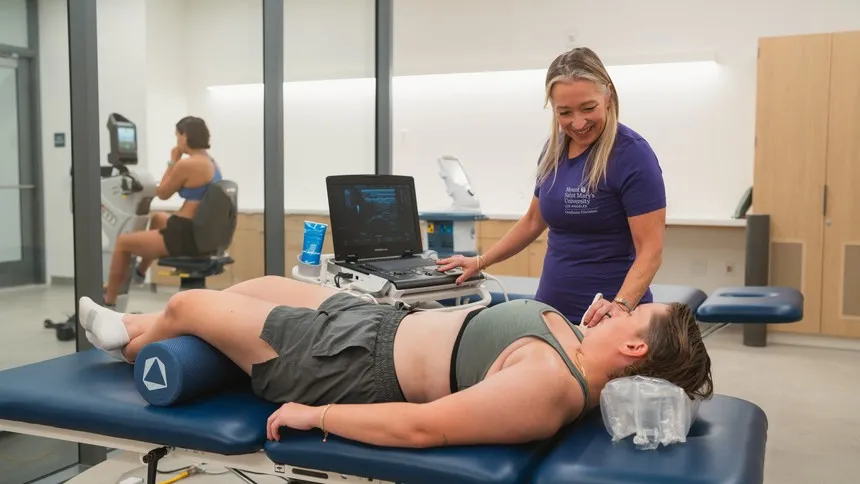
Students explore topics including women’s physiology, hormones, reproductive health, aging, nutrition, and the ways health conditions can develop and present differently in women.
“We teach students about the aspects of health that relate specifically to women,” said Hannah Nelson, PhD, director of the exercise science program and assistant professor. “Students will learn how these variables impact women’s access to, experience with and effects of exercise.”
The program also gives students opportunities to put that knowledge into practice at the Michael A. Enright Wellness Pavilion, where they conduct movement analysis, physiological testing and performance assessments. In the Fletcher Jones Foundation Advanced Training Lab, they gain hands-on experience developing clinical and research skills.
The result is an undergraduate degree that can lead directly into careers in health promotion, fitness management, wellness coaching and health advocacy while also providing a strong foundation for graduate education. “We see exercise science as a natural pipeline into the Doctor of Physical Therapy program, for example,” Nelson said.
That connection illustrates one of the larger goals of the University’s health sciences expansion: creating pathways that allow students to build on their education and move into increasingly specialized roles.
Advancing nursing leadership
The Doctor of Nursing Practice (DNP) extends the 91ɬÂþ’s long history in nursing education into a new generation of healthcare and nursing leadership. Launching in Spring 2027, the online DNP will prepare students to go beyond individual patient care and help shape the future of healthcare. Guided by the Roy Adaptation Model, the program combines online coursework with in-person clinical residency experiences and prepares students who want to influence healthcare systems or educate future nurses.
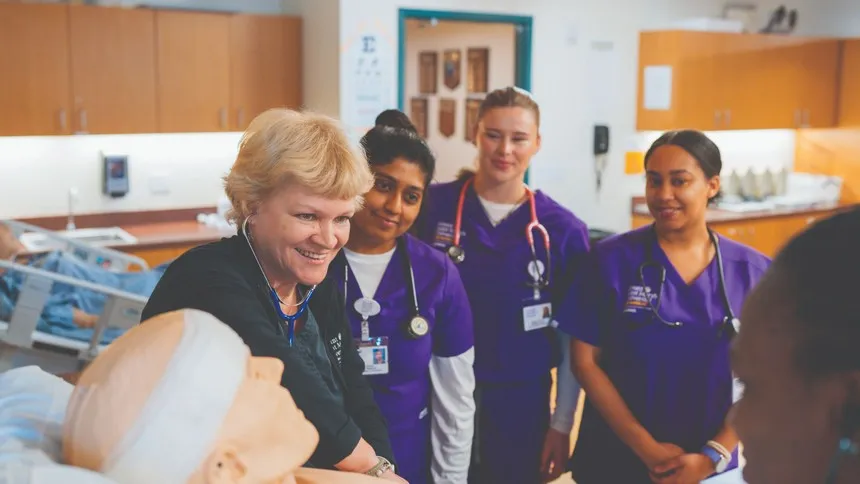
“What makes the 91ɬÂþ’s DNP distinctive is the emphasis we place on the whole nurse and the whole community,” said DNP Director Beverly Brownell, PhD, FNP, PMHNP-BC, RN. “The healthcare workforce shortage cannot be solved simply by producing more nurses. We need nurses who can transform the way healthcare is delivered.”
Students can pursue one of two tracks: Nursing education, preparing graduates to develop curricula, lead academic nursing programs and educate the next generation of nurses; or organizational leadership, focused on quality improvement, strategic planning, healthcare systems and leading change within complex organizations. The 37-unit program can be completed in two years, with a three-year option for working professionals.
The program emphasizes evidence-based practice, population health, technology, quality improvement, nursing entrepreneurship and leadership, equipping graduates to identify problems and evaluate solutions. Whether improving patient safety, redesigning clinical workflows, addressing workforce challenges or reducing health disparities, DNP prepared nurses can influence healthcare well beyond individual patient care.
“Our goal is to prepare the next generation of nursing leaders to translate evidence into practice, advance quality and patient safety, lead transformative change in healthcare, and educate and mentor future generations of nurses,” said Collazo.
Preparing providers for communities that need them
The new Master of Physician Assistant Studies (MPAS) program will add another dimension to the University’s health sciences portfolio. The two-year program, scheduled to launch in Spring/Summer 2029, will combine 12 months of classroom-based education with 12 months of clinical rotations. Designed for students who already hold a bachelor’s degree, the program will prepare graduates to practice medicine collaboratively with a physician across a range of healthcare settings.
“The PA profession is uniquely positioned to meet the evolving needs of modern healthcare because of the versatility and flexibility of our training,” said Jamal Bracken, DMSc, MPAS, MSHA, PA-C, the new director of the MPAS program and assistant professor. “Our goal is to prepare clinically strong, adaptable, patient-centered PAs who can serve patients across specialties and settings, particularly in communities with limited access to care or unmet needs.”
That flexibility is one of the profession’s defining characteristics. Graduates may work in hospitals, urgent care, primary care and other clinical environments, as well as in organizations such as nonprofits, home care agencies and pharmaceutical and biotechnology companies.
For the 91ɬÂþ, the program also represents an opportunity to prepare healthcare professionals with a particular understanding of the communities they will serve.
The program will add another potential pathway for students interested in addressing healthcare access, particularly in communities where primary care and other services remain difficult to obtain.
Building a health sciences ecosystem
Taken together, the three programs represent more than an expansion of the University’s academic offerings. They create a broader continuum of opportunities and interprofessional collaborations in health sciences, giving students new ways to translate their education into meaningful careers while preparing them to address real-world healthcare challenges.
“Teaching at the 91ɬÂþ is not just theoretical, but geared to solving real problems and advancing healthcare advocacy,” Weyhaupt said. “Today’s professionals must also understand inequities in access, communicate across disciplines, advocate for patients and adapt as healthcare systems evolve.”
This expansion comes at a time when students are increasingly looking for ways to translate their education into meaningful careers in health and wellness.
“We are seeing strong demand from students in health sciences,” Weyhaupt said. “They are excited about having more options, and we want to make sure these pathways prepare them to think critically, understand the people and communities they serve, and make a meaningful impact on healthcare.”


